
FEATURED ARTICLE
The History of Mooncakes in Singapore: From Tradition to Artisan
Old Seng Choong
Published on 23 October 2026 • 4 minutes

The History of Mooncakes in Singapore: From Ancient Tradition to Modern Artisan
Few foods carry as much meaning in as small a parcel as the mooncake. A single round pastry holds centuries of legend, a story of migration across the South China Sea, and — in Singapore — a very local appetite for reinvention. Every Mid-Autumn Festival, which in 2026 falls on Friday, 25 September, the mooncake reappears in reunion dinners, office gift exchanges and shopping-mall fairs, as familiar as it is quietly historic.
This guide traces that journey: where the mooncake came from, how it arrived on our island with Chinese immigrants, the regional styles that shaped the local version, and how Singapore turned a traditional pastry into a playground for snowskin, durian and artisan craft.
Origins: The Mooncake and the Mid-Autumn Festival
The mooncake is inseparable from the Mid-Autumn Festival, an autumn harvest celebration tied to the fullest, brightest moon of the lunar year. The festival itself is ancient, rooted in moon worship and gratitude for the harvest, and the round mooncake — echoing the shape of the full moon — became its edible symbol of reunion and completeness.
The timing is no accident. Mid-Autumn falls on the fifteenth day of the eighth month of the lunar calendar — the point in the farming year when the harvest was gathered and the moon sat at its roundest and brightest. Because it follows the lunar calendar, the date shifts against the Western one each year, which is why the festival can land anywhere from mid-September to early October; in 2026 it is Friday, 25 September. Originally a moment to thank the heavens for a good harvest, it gradually became a festival of family reunion, with the shared mooncake at its centre — and that double meaning, gratitude and togetherness, is what the pastry still carries today.
The most-told origin story is a rebellion legend. As it goes, during the fourteenth century, messages coordinating an uprising against Mongol rule were smuggled inside mooncakes and passed from household to household, the plot hidden in plain sight among festival gifts. It is a wonderful story and a staple of every Mid-Autumn retelling — but it is best treated as folklore rather than documented fact. What is clear is that by later imperial times, exchanging mooncakes at the festival was an established custom, and that custom travelled wherever Chinese communities settled.
Woven through the festival is a gentler legend, too: that of Chang’e, the moon goddess. In the best-known version, the archer Houyi is given an elixir of immortality, and his wife Chang’e drinks it to keep it from falling into the wrong hands, floating up to live on the moon. Each Mid-Autumn, people are said to gaze at the full moon in her memory — which is partly why the festival is a night for looking up, for lanterns, and for being together under the same bright sky.
That symbolism is what gives the mooncake its weight. The cake is round like the full moon, and roundness in Chinese culture speaks of wholeness and reunion; sharing one cut into wedges, so that everyone at the table takes a piece, is a quiet enactment of family unity. Alongside the mooncakes came the festival’s other markers — paper lanterns, pomelo, and tea — and the whole ritual of gathering that would, in time, be re-created thousands of kilometres away.
How Mooncakes Came to Singapore
Mooncakes arrived in Singapore the way so much of our food culture did: in the luggage, memory and homesickness of immigrants. From the nineteenth century onward, large communities from southern China — Hokkien, Teochew, Cantonese, Hainanese and others — made the island home, bringing their dialect-group festivals and the foods that anchored them.
Mid-Autumn was one of those anchors. Early clan associations and temples marked the festival, and the first mooncakes here were either made at home or bought from small Chinatown confectioneries and traditional bakeries, some of which still trade today. For a migrant community, a mooncake was more than a sweet: it was a thread back to the home village, a way to keep an ancestral calendar alive in a tropical port city far from the mid-autumn chill.
Clan and dialect associations played an outsized role in keeping the festival alive. These organisations held reunion gatherings, distributed mooncakes among members, and reinforced the customs each group had carried from a particular corner of southern China. The cakes themselves adapted to local conditions: a humid, equatorial climate with no autumn to speak of, different available ingredients, and eventually a multicultural marketplace in which Malay, Indian and Peranakan flavours were never far away. The Singapore mooncake, in other words, began drifting from its ancestral template almost as soon as it arrived.
As the island prospered, the festival also became a commercial season. Established confectioneries built annual mooncake businesses, hotels and restaurants began competing for the gifting market, and Mid-Autumn shifted from a purely domestic ritual into a visible retail event marked by shopping-mall fairs and elaborate displays. That commercial energy is what later bankrolled the experimentation — and it is also why local flavours crept in. Pandan, gula melaka, yam and even bak kwa began appearing in mooncakes, quietly rewriting the recipe in a Singaporean accent long before “fusion” was a marketing word.

Regional Styles That Shaped the Local Mooncake
Because Singapore’s Chinese community is made up of several dialect groups, the “Singapore mooncake” was never a single thing. Three traditions in particular shaped what we eat today.
Cantonese Baked: The Mainstream Classic
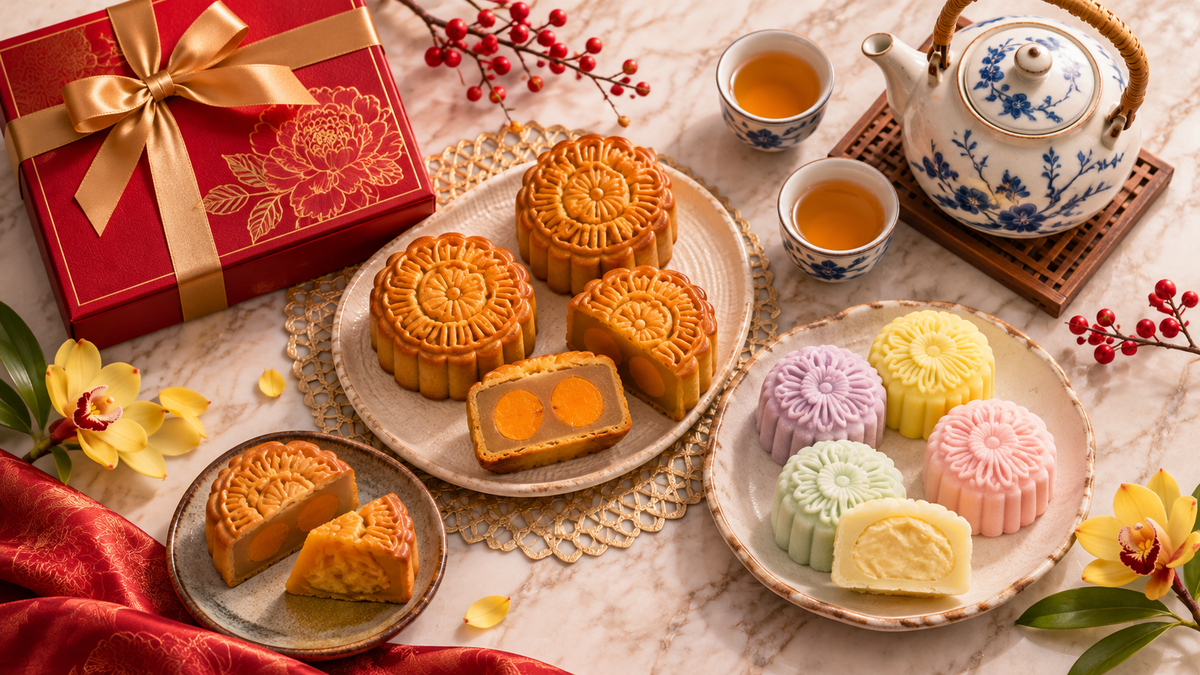
The style most people picture — a glossy, golden baked skin made with alkaline syrup, wrapped around smooth lotus-seed paste and one or more salted egg yolks — is Cantonese in origin. Its tender, slightly chewy crust and rich, not-too-sweet filling made it the commercial standard, and it remains the benchmark against which most mooncakes are still judged. The single, double or even quadruple yolk became a kind of shorthand for generosity — more yolks, a more lavish gift — and the burnished top, stamped with auspicious characters, turned each cake into a small, edible emblem of good wishes. It is this version that most Singapore bakeries and hotels still build their ranges around.
Teochew Flaky: The Spiral Pastry
The Teochew contribution is textural: a flaky, many-layered pastry, often spiral-patterned, traditionally filled with smooth yam (orh nee) paste. Where the Cantonese cake is dense and burnished, the Teochew style shatters into delicate leaves — a reminder that “mooncake” describes a family of pastries, not one recipe.
Traditional Wu Ren: The Five-Nut Original
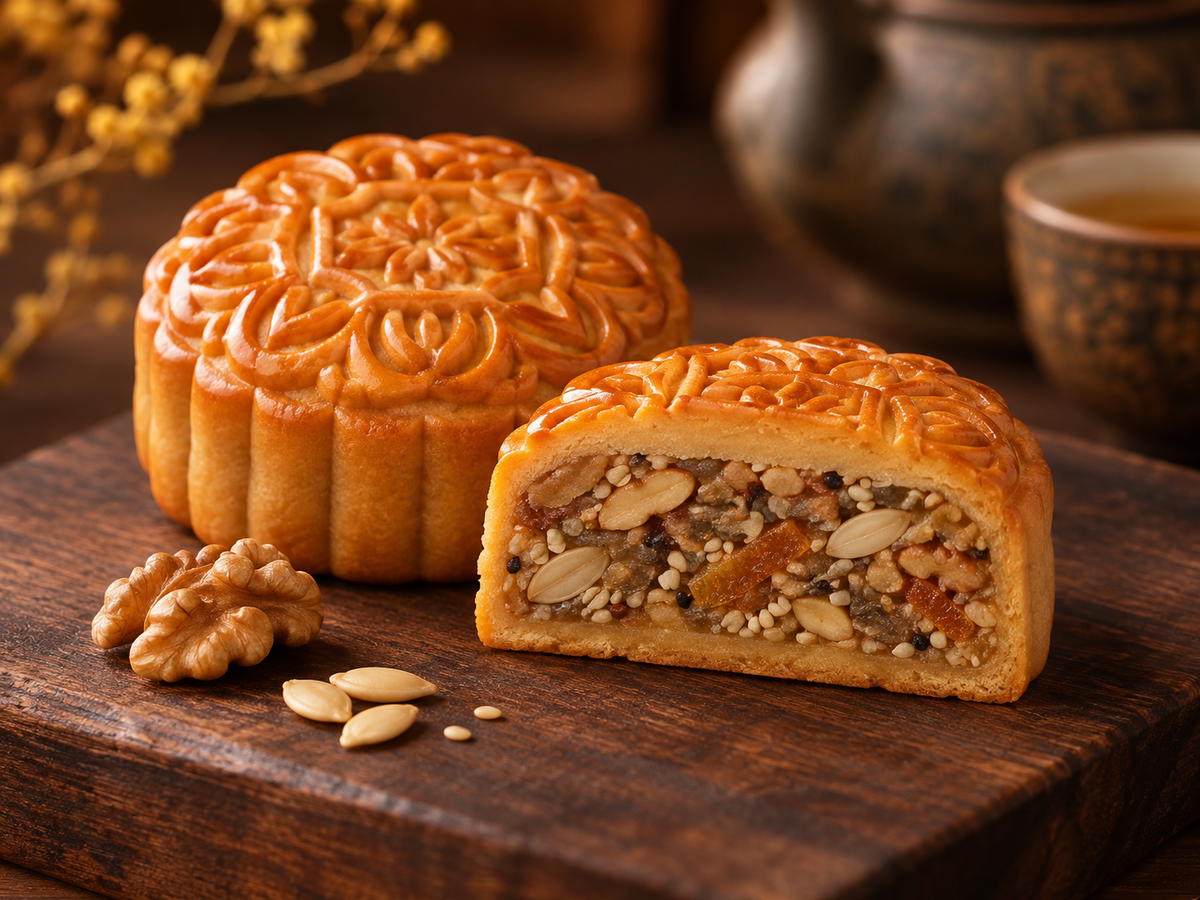
Older still is wu ren — the “five kernels” mooncake packed with assorted nuts, seeds and candied winter melon, sometimes bound with cured ham in its savoury form. Dense, chewy and famously polarising, wu ren is one of the oldest fillings of all, prized by heritage buyers even as younger eaters debate it.
Other communities added their own touches — Hainanese and Hokkien families had their variations, and over generations the styles cross-pollinated in Singapore’s shared kitchen. The upshot is important for understanding the local mooncake: there was never one “correct” version to preserve. From the start, the Singapore mooncake was plural — several traditions sitting side by side on the same festival table — which is precisely what made the later wave of reinvention feel so natural.

The Modern Turn: Snowskin, Durian and Artisan Boxes
If the twentieth century in Singapore was about preserving tradition, the past few decades have been about reinventing it. The biggest shift was the arrival of the snowskin (冰皮) mooncake — a chilled, soft, mochi-like cake with no baked crust at all. Served cold and endlessly colourful, snowskin opened mooncakes up to fruit, tea, chocolate and, above all, durian.
Durian is where Singapore truly made the festival its own. Mao Shan Wang and D24 snowskin mooncakes turned the season into a local obsession, and durian specialists now compete each year on pulp purity and intensity. It is a telling bit of culinary confidence: the region’s most divisive fruit, folded into one of its most traditional pastries, and embraced so completely that a durian snowskin now feels as “Mid-Autumn” as lotus paste and salted yolk ever did. Each year the grades, the percentages of pure pulp, and the sugar levels become talking points in their own right.
Alongside them, hotels pushed the luxury end — champagne-truffle snowskins, gold-dusted boxes, savoury truffle-and-ham creations — while health-conscious makers introduced low-sugar and halal-certified ranges so more people could take part. That last shift matters: by certifying kitchens halal and offering vegetarian and reduced-sugar options, makers turned a once dialect-specific custom into something the whole of multicultural Singapore can share.
The artisan turn reshaped who makes mooncakes, too. Where the season was once the preserve of traditional confectioneries, it now draws in hotels, pastry chefs, independent bakers and heritage brands, each competing on flavour invention and design. Limited-edition collaborations, chef’s signatures and single-origin ingredients became selling points, and the annual “best mooncakes” lists turned the festival into a genuine culinary event rather than a simple restock of an old favourite.
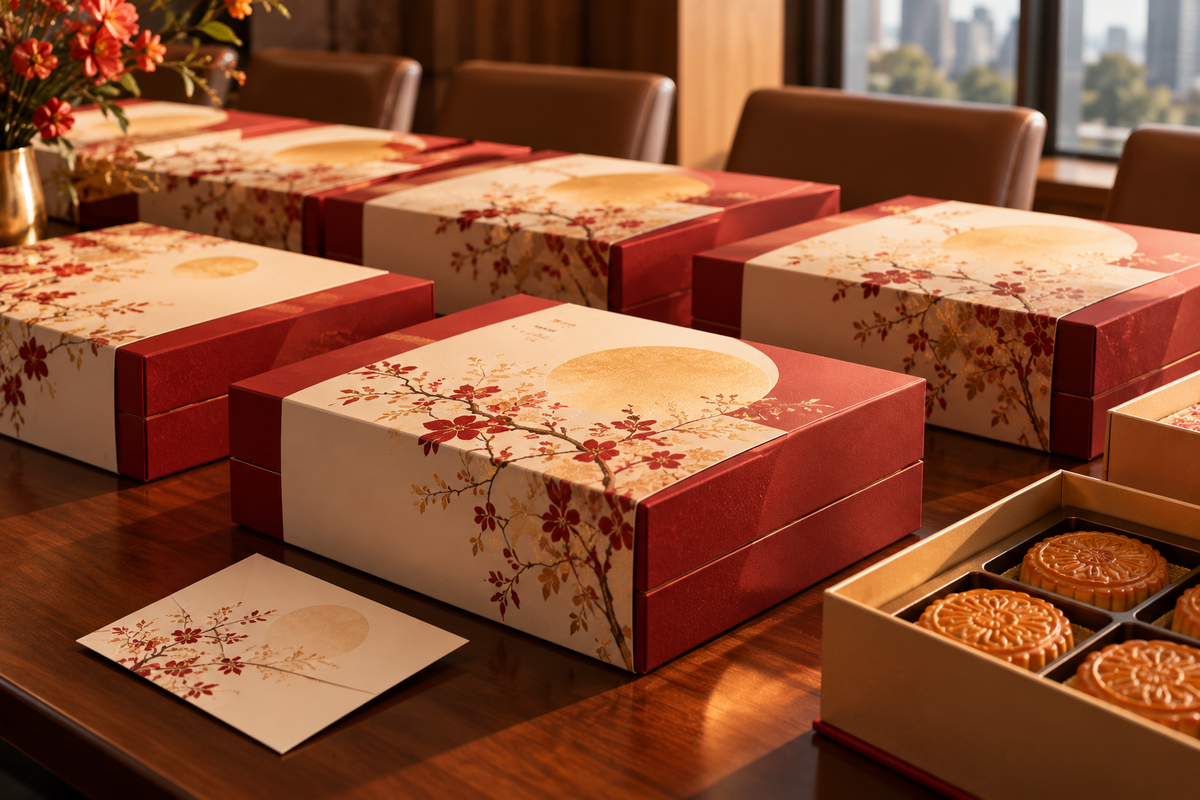
Packaging evolved just as fast. The mooncake box became a keepsake: lacquered tins, modular lantern boxes, embossed gift sets — and, more recently, sustainable, reusable designs — all engineered to live on the shelf long after the cakes are gone. For a gift-giving festival, the box carries real weight, and makers now invest in it almost as heavily as in the cakes inside. The result is a season that runs on two tracks at once — deep tradition and restless innovation — often sitting side by side in the same gift box.

Old Seng Choong: Carrying Heritage Forward
Among the names bridging those two tracks is Old Seng Choong, a homegrown heritage confectioner founded by Daniel Tay that builds its reputation on locally-inspired flavours and unhurried craft. Its 2026 collection, Six Harmonious Woven, is a good illustration of where the local mooncake now sits — a contemporary assorted box that leans on recognisably Singaporean pairings while keeping the gift-giving ritual, and the keepsake packaging, firmly intact.
What makes the heritage-maker’s role interesting is the balancing act. Lean too far into nostalgia and the mooncake becomes a museum piece; chase novelty too hard and it loses the meaning that made it worth giving in the first place. The brands that endure tend to hold both at once — honouring the baked classics an elder expects while giving younger buyers a reason to look twice — and packaging it all in a box worth keeping.
That is, in a sense, the whole history in miniature: a pastry carried here by immigrants, shaped by dialect traditions, and continually remade for the city it now belongs to. Each September, when the boxes reappear and families gather under the same full moon that Chang’e is said to watch from, the mooncake does what it has always done — it carries a little history, quietly, in a single round parcel.
Frequently Asked Questions
Old Seng Choong – Tradition Meets Taste.
About Us
Baby Full Month
Corporate Orders
Blog - In The Spotlight
Tasty News In Your Inbox
Be the first to know about our special offers, new product launches, and events.
Tasty News In Your Inbox
Be the first to know about our special offers, new product launches, and events.
Tasty News In Your Inbox
Be the first to know about our special offers, new product launches, and events.
Stay Connected


Old Seng Choong Pte Ltd
GST REG. NO. 201540527H
2026 All rights reserved.

